

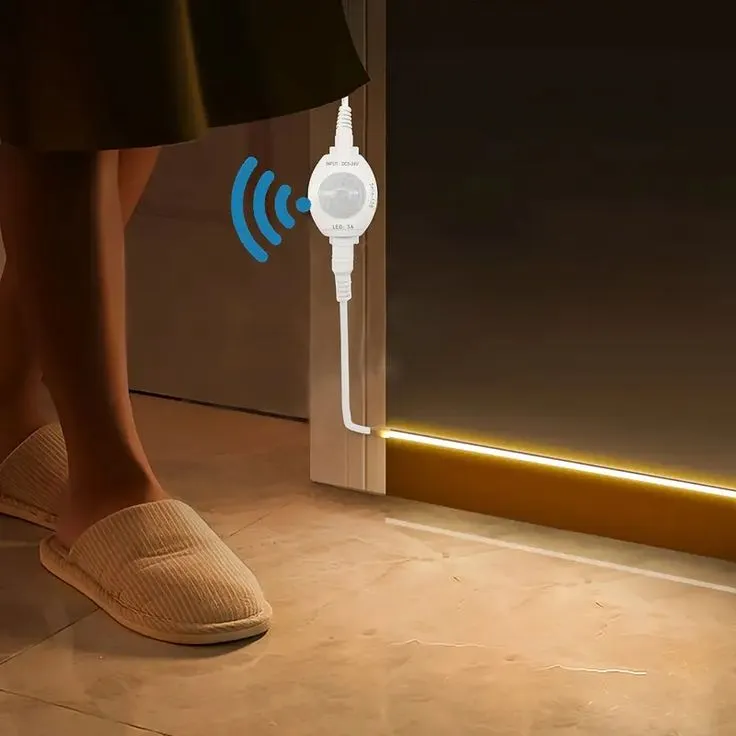
LED strip lighting is more useful if it can react to the way a space is used. Users can program lights to brighten, dim, and/or turn on based on motion without turning them on or off individually. Smart control is useful in the home, office, retail, cabinets, corridors, etc., where convenience is important. The choice of the right control method should take into account: LED strip, power supply, installation environment and daily lighting needs.
Start With the Lighting System
It is important to determine the LED strip used before choosing a control device. Look at the voltage, power usage, color setup and connection.
A WiFi Controller for LED strip can provide wireless control through a compatible network, or application, depending on the product. This setup makes light changes simple without mounting a standard hardwired switch in every single room.
Wireless control should be designed for the total system, though. The controller must be compatible with the LED strip and the power supply. The range of communication must be appropriate for the installation area.
Consider How the Space Is Used
The optimum control will depend on the activities that are carried out in the area. A kitchen could use a light that is easily dimmed and brightened, or a hallway that only lights when someone walks in.
Consider the typical lighting use and the need for continual control. There are various requirements for different areas such as offices, retail displays, bedrooms, cabinets or corridors.
Convenient controls can minimize “needless manual switching” for a frequently used area. Scheduled settings can let the system run during business hours or family activities, when it is used for decorative lighting.
Use Motion Detection Were Useful
Lights are not necessary in some sites to be active all the time. Automatic activation can be utilized when movement occurs, such as in storage areas, closets, hallways, stairs, and cabinets.
PIR Sensor for LED strip is able to sense the change of movement and activate suitable lighting devices. This will be helpful in situations where the user might not wish to look for a switch in a dark environment.
It is crucial to place the sensors correctly. The detection area should be designed to detect animals that are likely to be making contact, but not to purport to detect those that are not. Before mounting, the detection range and mounting requirements of the sensor need to be verified.
Combine Sensors with Smart Controls
The functions of smart controls and sensors can vary. Manual adjustment can be done via wireless control; automatic adjustment can be done by a motion sensor when lights go on.
For instance, a cabinet lighting system can turn on when someone walks up, and the user can still control the brightness via a compatible control interface. For a commercial corridor, lighting can turn on when people are walking through and adjust according to a set time schedule.
The ability of these functions to operate in synergy will depend on the equipment used. Therefore, before mixing multiple control devices, their compatibility should be ensured.
Check Power Requirements
Controllers and sensors won’t provide the power that the LED strip needs. The entire system requires a suitable and compatible power supply.
Find the total power draw for your light tape by checking the package details and the full line length. Next, verify the power supply is capable of handling the load.
The lighting’s electrical properties should also be considered in the controller’s rating. Where the installation is larger than this, there may be zones needing separate power arrangements or the need for additional components.
These calculations should be kept in order before installation, to avoid any unneeded changes afterward.
Plan Wireless Connectivity
Wireless control may be convenient, but should be taken into account in the installation environment. Walls, cabinets, building materials and spacing between devices can impact wireless communication.
Test the connection of the controller from the proposed location before mounting it permanently. This is especially helpful in larger buildings where the lighting is located away from the network equipment.
Think about what happens when Wireless connectivity is not available for a while. Users can also have other local control options, depending on the controller. These details help ensure that the lighting is also practical for everyday use.
Think About Sensor Placement
The best placement for a motion sensor is when it is located according to the pattern of movement in the space. The performance can be affected by the mounting height, detection angle, proximity of objects, and people coming from different angles.
Do not position the sensor against furniture and architectural features that would prevent the sensor from detecting the presence of a person. Sometimes a poorly placed sensor may trigger just in time, but not in other cases.
Compact placement may also be important for cabinet and under-shelf applications, as the sensor must be placed where it will not be too visible, but it is still able to cover the desired area.
Conclusion
Test each component of the system as a unit before installing. Test the LED strip and power supply, check the controller, wireless link, sensor response, brightness setting and programmed functions. Go through the space in various paths and check if the sensor changes at the desired distance. When using smart controls, test the connection from where the users are most likely to control the lighting. These checks can detect problems when wires and components are still accessible. They also help to validate that automation does not compromise the use of the lighting. Smart LED control works best when automation and manual operation are planned around the actual needs of the space. Professionals and project planners can explore richeelighting.com for LED control components and related lighting solutions suited to different installations.